Tailhook Aircraft - A tail hook, tail hook, or tail hook is a device that attaches to the empnand (rear) of some fixed-wing military aircraft. The hook is used to achieve rapid deceleration during routine landings on aircraft carriers at sea, or during emergency landings or aborted takeoffs at well-equipped airfields.
The tail hook was first demonstrated at sea on January 18, 1911 by aviator Eugene Ely, after he successfully landed on the armored cruiser USS Pennsylvania using the device. It was not until the early 1920s that a practical system, combined with deck arresting equipment, was devised and put into use. In the 1930s, numerous ships were equipped in this way, which during the Second World War enabled the use of increasingly heavy combat aircraft at sea. After the introduction of jet-powered aircraft in the 1950s, arrestor technology was further advanced to allow aircraft operating at higher speeds and weights to land on the aircraft. The system continued to be widely used in the twenty-first century.
Tailhook Aircraft
On January 18, 1911, aviator Euge Ely took off in his pusher Curtiss airplane from Tanforan Airport in San Bruno, California and landed on the deck of the armored cruiser USS Pennsylvania at anchor in San Francisco Bay,
Grumman F 14 Tomcat Landing With Tailhook Extended Tapestry By Wernher Krutein
In the first recorded airplane landing. This flight was also the first to use the tail hook system, designed and built by circus performer and aviator Hugh Robinson. After the summer, Eli remarked to a reporter, “It was easy. I think the trick could be successfully twisted nine times from t. About four months later, the United States Navy would request its first aircraft, often considered a milestone in naval aviation.
Although the system initially attracted limited attention, greater recognition of its merits came after the outbreak of the First World War.
Naval planners recognized that for aircraft to be a viable naval asset, they would need to be able to board and land on ships. During the Great War, the number of US Navy aircraft increased from 38 to 1,650, which performed numerous tasks in support of the Allies, specializing in combat air patrols and spotting submarines.
The first practical tail hook and stop gear arrangement was devised at this time; On April 1, 1922, the US Navy issued a design request for arresting equipment to equip a pair of aircraft carriers, the USS Leckington and the USS Saratoga.
U.s. Navy Petty Officer 3rd Class Roshan Goshai Services The Tailhook Accumulator On An F/a
During the early 1930s, the US Navy began developing an adjustable hydraulic-based assembly, which was shown to absorb the energy of landing aircraft not only at higher speeds, but also at heavier weights.
As military aircraft continued to grow in weight and flight during World War II, Naval Air Wings were forced to continue to innovate and improve their aircraft recovery systems. During the 1950s, as a result of the introduction of jet aircraft for aircraft carrier operations, both landing speeds and tail hook loads increased significantly.
The US Navy developed and operated a test rig in the 1950s, consisting of a vehicle supported by a concrete I-beam and powered by a pair of jet engines. At the end of the one-mile run, the lower tail hook would measure the arrester wire, while the I-beam guide gradually expanded to slow the test car after passing the arrester wire, acting as a safeguard in case of arrester failure. . The test rig was able to simulate different aircraft weights and speeds, the former being adjusted by adding or subtracting steel plates that were loaded onto the modified car.

These tests supported efforts to develop even more efficient exhaust devices suitable for the larger and more powerful jets that were coming into naval aviation at the time.
Easiest/hardest Aircraft To Trap On A Carrier?
While the tail hook is mainly used in a maritime context, many land-based aircraft are also equipped with them to assist with delayed landings during emergency situations. A very unusual incident known as "Pardo's Push" occurred during the Vietnam War in March 1967, in which a US Air Force McDonnell Douglas F-4 Phantom II piloted by Bob Pardo assisted another heavily damaged Phantom II coming out of the fight. zone by pushing his aircraft onto the tail hook of another for deployment, said to temporarily halve the descent rate.
In the twenty-first time, the tail hook remained part of the main means of landing aircraft at sea for various navies, including the United States. In the 2000s, the Dassault Rafale, a French multirole fighter, became the only non-US fighter authorized to operate from the decks of US carriers, using catapults and their arresting equipment, as demonstrated in 2008, where six Rafales from Flotilla 12F is integrated into the USS Theodore Roosevelt Carrier Air Wing Interoperability Exercise.
In the 2010s, new software tested with the Boeing F/A-18E/F Super Hornet fighter jet reportedly showed promise in streamlining carrier landings.
During flight tests of the new Lockheed Martin F-35 Lightning II, one of the serious flaws that required redesign and delay was the failure of the Navy's F-35C variant to engage the arrest wire in all eight landing tests; the tail hook had to be redesigned over a period of two years.
Retired Local Navy Pilot Makes Return Trip To Tailhook
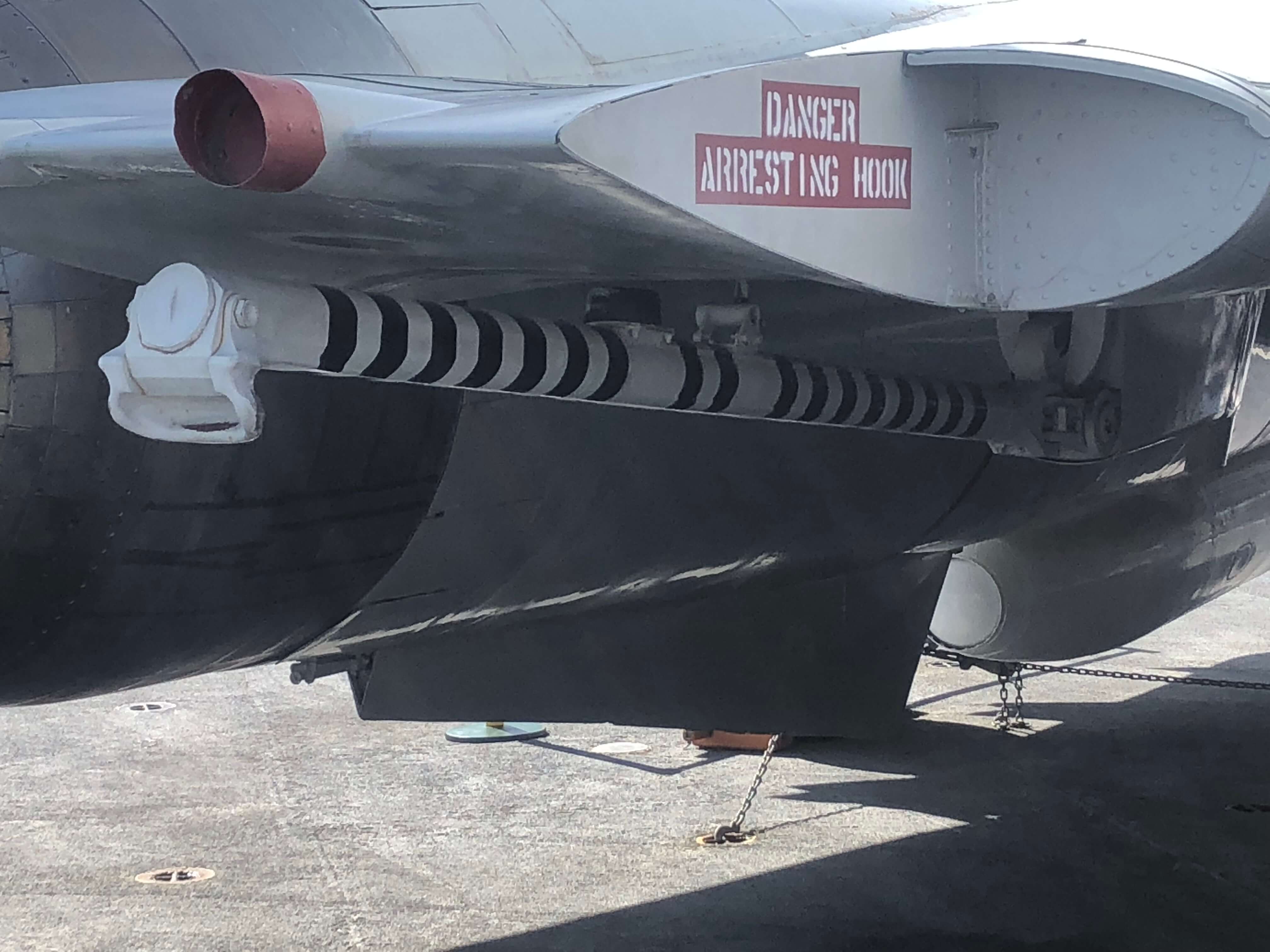
The tail hook is a strong metal bar, with a free d, flattened, slightly thickened and shaped into a claw-like hook. The hook is mounted on a swivel on the nose of the aircraft and is normally mechanically and hydraulically held in the stowed/burned position. When activated by the pilot, hydraulic or pneumatic pressure lowers the hook to the down position. The assumption of a tail hook is not proof of aircraft suitability. Aircraft carrier hooks are designed to be quickly raised by the pilot after use.
Many land fighters are also equipped with tail hooks, which are intended for use in the event of brake/tire failure, aborted starts or other emergencies. Landing gear and tail hooks of land-based aircraft are usually not strong enough to absorb the shock of a carrier landing,
And some tail hooks on land are held pressurized by nitrogen-pressurized systems that must be topped up by ground personnel after deployment.

Both the carrier and the ground arresting gear consist of one or more cables (known as "arrest wires" or "transverse deck pads") stretched across the landing area and attached to both d to the arresting mechanisms by "buying cables".
Navy's F 35 Tailhook Passes Initial Tests; Carrier Flights In October
In a typical rack configuration, a total of four drain wires are pre-installed. The function of the tail hook is to hook one of these cables, preferably the third of the four available, so that the resistance of the arrester can be transferred to the plane, so that it can slow down more quickly.
Before performing a "stop landing," the pilot lowers the hook so that it makes contact with the ground as the airplane's wheels descend. The hook is dragged along the surface until the stop cable, stretched across the landing area, is secured. The cable releases, transferring the aircraft's energy to the stop gear through the cable. A "trap" is often used for an arrested landing. An aircraft that lands outside the arresting cables is said to be "protected". Occasionally, the tail hook bounces over one or more strings, resulting in a "hook skip screw".
In the event of an aborted land launch, the hook may be lowered at some point (usually about 1,000 feet) before the cable. If an aircraft's tail hook breaks or is damaged, naval aviators have limited options: they can divert to land runways if one is within range, or they can be "barricaded" on the carrier's deck with a retractable net. I intend to expand on my first discussion of the tail hook (HERE). The recent problems with the F-35C brought the topic to the top of the list. More on that after a brief history of the tail hook.
The first landing of an airplane on a US Navy ship, the cruiser Pennsylvania, was made by civilian pilot Eugene Ely on January 18, 1911 - so 2011 was the centennial of naval aviation. A temporary wooden platform about 134 feet long and 32 feet wide was added aft of the mainmast, extending aft over the after turret and alongside the stern of the ship. Angle up from the fan, the first 14-foot section at about a 30-degree angle, and the rest, less steep, but still "appealing," to help slow the plane. Two low, wooden guides ran back and forth on the platform about 12 feet apart to help keep the plane on the deck. Two low canvas screens were stretched across the deck about ten feet from her forward end, and a tall canvas screen was hung from a mast at the forward end of the platform. This supplies the obstacles and barricades used on the deck axial supports to protect the forward crew and hopefully the pilot in the event the aircraft overshoots the landing area. Canvas was also hung outboard on either side of the forward two-thirds of the landing area to keep it in place
The Gauntlet: Women Wanted To Fly Jets In Combat. It Would Prove The Fight Of Their Lives.
Tailhook towing, navy tailhook, aircraft tailhook for sale, oakley tailhook replacement lenses, oakley tailhook lenses, oakley tailback vs tailhook, eberlestock tailhook, tailhook brace, oakley tailhook, tailhook association, oakley tailhook sunglasses, tailhook


0 Comments